Barry Manilow Songs .win Will I See You Again
| "Could It Exist Magic" | ||||
|---|---|---|---|---|
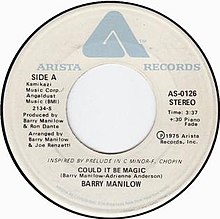 A-side label of 1975 US vinyl unmarried | ||||
| Single by Barry Manilow | ||||
| from the album Barry Manilow | ||||
| A-side | "Atrophy" (1973 solo version) | |||
| B-side |
| |||
| Released |
| |||
| Recorded | 1970, 1973, 1975 | |||
| Genre | Soft rock[i] | |||
| Length |
| |||
| Characterization |
| |||
| Songwriter(s) |
| |||
| Producer(south) | Tony Orlando (1971 version)
| |||
| Barry Manilow singles chronology | ||||
| ||||
| ||||
"Could Information technology Be Magic" is a song with lyrics by Adrienne Anderson and music by Barry Manilow, inspired by Frédéric Chopin'south Prelude in C minor, Opus 28, Number 20.
The song was initially released in 1971 by Bypass (a group of session musicians featuring Barry Manilow), produced and co-written by Tony Orlando. Information technology was later re-recorded every bit a Barry Manilow solo runway in his first album released in 1973 on Bell Records. It was then reworked in 1975 and released as a single from the album re-released by Arista Records. The 1975 release became Manilow's third hitting subsequently "Mandy" and "It's A Miracle".
The song has been recorded by a number of other artists over the years, near successfully by Donna Summer in 1976 and by Accept That in 1992. The version by Accept That won the Brit Award for British Unmarried in 1993.
Composition and recordings [edit]
Manilow wrote "Could Information technology Be Magic" 1 night while he was living in a studio apartment on 27th Street in Manhattan. He had been playing Chopin on the piano that afternoon and the tune inspired by Chopin and so came to him.[ii] Manilow congenital the song past elaborating on role of Chopin'southward Prelude Op. 28, No. 20, and the source of the inspiration is fabricated explicit in Manilow'due south ain recording, which quotes straight eight bars of Prelude No. 20 at the first, and ends the aforementioned way by returning to the Prelude.[3] The basic shape of the song is that of a single great crescendo;[iv] as Manilow explained, he wanted the vocal to "build and build" similar the Beatles's "Hey Jude" "until you remember you can't take information technology anymore. It should exist a musical orgasm."[5]
Manilow sent a cassette tape of his tune to his collaborator Adrienne Anderson, who responded enthusiastically to the vocal, equally did Tony Orlando,[2] vice-president of Columbia/CBS Music, who too contributed lyrics to the version of the song he so produced.
Bypass version [edit]
Manilow was signed by Orlando to New York-based Bell Records in 1969,[6] and Orlando produced a few songs released under the name of Bypass, a "ghost" group consisting of session musicians including Manilow. Bypass had a modest success with "Amy" in 1971, a song written by Anderson and performed past Manilow.[vii] Manilow at that phase had only equanimous or arranged commercial jingles, and the organisation of the backing track for "Could It Exist Magic" was left to Orlando afterward they had a word about the song'due south arrangement. Although Manilow had envisioned a song that builds upward like "Hey Jude", Orlando produced and arranged information technology instead as an uptempo bubblegum pop single with a dance beat and cowbells that more resembled Orlando's own "Knock Three Times".[eight]
This early version of "Magic" was released every bit a song by Featherbed on the Bong Records label.[9] [10] Manilow hated the Tony Orlando organisation in Featherbed'south version so severely (come across Sugariness Life) that, as he has said in numerous subsequent interviews, he was appreciative of the fact that the song went nowhere on the charts. Nonetheless, he has been quoted in recent years as having somewhat softened his opinion of the track, proverb it's "kind of catchy".[ citation needed ] Apart from the chorus, the original verse lyrics accept null to do with the version Manilow himself recorded for his debut album in 1973 and in 1975.
Manilow solo versions [edit]

Manilow in a 1975 publicity photograph
Manilow co-produced a slower-tempo version the song with Ron Dante. Although the chorus of this version is similar to the Bypass version, the residual of the lyrics are completely different. The "Sugariness Melissa" in the lyrics is said to refer to vocalist Melissa Manchester, who was Manilow's characterization-mate and a back-upwards vocaliser to Bette Midler in the early 1970s.[three] Information technology was released on his debut album Barry Manilow in 1973, and served equally the B-side to the single "Cloudburst".[11]
Vi months later, former Columbia Records president Clive Davis took over Bong Records and merged information technology into Arista with all the other Columbia Pictures-owned labels. Most of the artists at Bong were dropped during the merger, only Manilow was brought over to Arista in the spring of 1974. Due to the success of Manilow 2d album Barry Manilow II, it was decided that Manilow's debut album would exist re-released under the Arista label, to exist retitled Barry Manilow I. Manilow and Dante reworked 4 songs in April 1975 for the re-release, including a slightly altered version of "Could It Exist Magic",[12] co-arranged with Joe Renzetti.[13] Clive Davis heard the song and decided to release it as a single for the Arista re-release despite its length of nearly 7 minutes (nearly singles then were around three minutes long), reasoning that even if information technology failed to make an bear upon, people'due south attending would be diverted by Manilow'due south before longhoped-for-released third album.[12] To brand the song radio-friendly, information technology was shortened to only over iv minutes for its single release by cutting the bridge in half, deleting the start half of the 2d verse, and reducing the number of repeats in the final chorus.[14] The unmarried turned out to be successful and reached number 6 in the United states of america.[fifteen] Cash Box said that "a glowing arrangement by Manilow and Ron Dante grace the familiar melody which is augmented with a strong, vocal interpretation by Manilow"[16]
The song also reached number 25 on the UK charts when information technology was issued equally a unmarried in 1978.
The song was once again reworked in 1993 using the earlier orchestration of brass and strings, combining information technology with new drums, bass and synthesizers. This version was included on the anthology Greatest Hits: The Platinum Collection. An extended remix of the 1993 version was issued equally a promotional 12" unmarried and included on the 12" single of "I'd Really Love to See Yous This evening".
Charts [edit]
Donna Summer cover version [edit]
| "Could It Exist Magic" | ||||
|---|---|---|---|---|
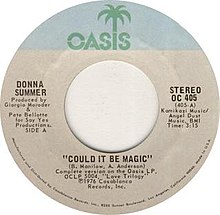 US 7-inch vinyl single | ||||
| Single by Donna Summer | ||||
| from the album A Love Trilogy | ||||
| B-side | "Whispering Waves" | |||
| Released | January 11, 1976 | |||
| Genre | Disco | |||
| Length | 3:fifteen | |||
| Label | Oasis | |||
| Composer(s) | Barry Manilow, Frédéric Chopin | |||
| Lyricist(south) | Adrienne Anderson | |||
| Producer(s) | Giorgio Moroder, Pete Bellotte | |||
| Donna Summertime singles chronology | ||||
| ||||

Donna Summer (pictured in 1977) recorded the vocal in 1975, the aforementioned year Manilow's version was released as a single.
Just 7 months after Manilow's original version was released equally a single, American vocalist Donna Summer recorded a disco version of the runway and included it on her tertiary studio anthology, A Dearest Trilogy, and took information technology to number 3 on the US Billboard Trip the light fantastic toe chart in 1976.[26] The song likewise entered the Britain Singles Nautical chart where it stayed for seven weeks (meridian betoken No. forty). Summer changed the lyrics of "sweetness Melissa" to "sugariness Peter" equally an ode to her boyfriend at the time, Peter Mühldorfer.
Track listing [edit]
- United states vii" unmarried (Oasis OC 405) / Canada 7" single (Oasis OC 405X)
- "Could It Be Magic" – 3:15
- "Whispering Waves" – 4:50
- UK 7" single (GTO GT 60)
- "Could It Be Magic" – three:15
- "Whispering Waves" – 4:l
- Federal republic of germany 7" unmarried (Atlantic ATL ten 775)
- "Could It Be Magic" – 5:twenty
- "Come With Me" – iv:twenty
- Netherlands 7" single (Slap-up GR 1219)
- "Could It Be Magic" – 3:xv
- "Whispering Waves" – four:50
- France 7" single (Atlantic x.770)
- "Could Information technology Be Magic" – 4:13
- "Whispering Waves" – 4:fifteen
- Italian republic 7" single (Durium DE 2873)
- "Could It Be Magic" – 3:15
- "Whispering Waves" – three:35
Charts [edit]
Weekly charts [edit]
| Nautical chart (1976–2012) | Peak position |
|---|---|
| Republic of austria (Ö3 Austria Pinnacle xl)[27] | xiv |
| Belgium (Ultratop 50 Flanders)[28] | five |
| Belgium (Ultratop fifty Wallonia)[29] | iv |
| Canada Top Singles (RPM)[thirty] | 64 |
| France (SNEP)[31] | 105 |
| Netherlands (Dutch Top twoscore)[32] | ii |
| Netherlands (Single Acme 100)[33] | 5 |
| South Africa (Springbok)[34] | 10 |
| Britain Singles (OCC)[35] | twoscore |
| United states of america Billboard Hot 100[36] | 52 |
| United states Adult Contemporary (Billboard)[37] | 47 |
| U.s. Hot R&B/Hip-Hop Songs (Billboard)[38] | 21 |
| West Germany (Official German Charts)[39] | 23 |
Year-end charts [edit]
| Chart (1976) | Position |
|---|---|
| Belgium (Ultratop Flemish region)[forty] | 35 |
| Netherlands (Dutch Top twoscore)[41] | 14 |
| Netherlands (Single Top 100)[42] | 20 |
Certifications [edit]
Take That cover version [edit]
| "Could It Be Magic" | ||||
|---|---|---|---|---|
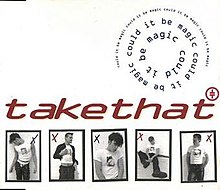 United kingdom Maxi-CD cover | ||||
| Unmarried by Take That | ||||
| from the album Take That & Party | ||||
| Released | November 30, 1992 (1992-11-xxx) [44] | |||
| Genre | Pop | |||
| Length | iii:thirty | |||
| Characterization | RCA | |||
| Songwriter(s) |
| |||
| Producer(s) |
| |||
| Take That singles chronology | ||||
| ||||
| Music video | ||||
| "Could It Be Magic" on YouTube | ||||
Produced past Baton Griffin and Ian Levine and remixed by the Rapino Brothers, English boy band Accept That released their cover version, based on Donna Summer/Giorgio Moroder's upwards-tempo arrangement of the rails, on Nov 30, 1992, every bit the last single from their debut anthology, Accept That & Political party (1992). The song does not announced on the cassette version of the album but was issued as a cassette single. It peaked at number three on the United kingdom Singles Chart and was featured in that year's But Fools and Horses Christmas special "Mother Nature's Son" in the background of one of the scenes. The single reached the top x in Belgium, Ireland, Portugal, and the United Kingdom. On the Eurochart Hot 100, "Could It Be Magic" peaked at number nine. The song won Take That their first major award: Best British Single at the 1993 Brit Awards.[45] [46]
During The Ultimate Bout in 2006, old member Robbie Williams appeared on a hologram with a pre-recorded section of his vocals.[47] Gary Barlow sings atomic number 82 vocals since Take That'southward reformation.
The vocal has received a Silver sales condition certification and has sold over 345,000 copies in the UK.
Disquisitional reception [edit]
In his review of the Take That & Party album, Peter Fawthrop from AllMusic wrote, "Hearing Robbie Williams on the tracks here, especially his atomic number 82 on the cover of Barry Manilow'south "Could It Be Magic", brings back a feeling of lost innocence and a perspective on the changing of times."[48] Music writer James Masterton commented in his weekly UK nautical chart commentary, "Cleverly they change it from a carol into a medium-tempo pop/dance tune just although it is also fancied for Christmas No.ane it is just not equally strong every bit songs like 'A Million Love Songs', their terminal hit which may well accept been a better choice for a Christmas single."[49]
Music video [edit]
A music video was produced to promote the single, directed by Saffie Ashtiany.[50] It shows a young woman leaving a garage before the lights are turned back on and Take That perform the song with many other dancers. Information technology was filmed at Bray Studios, Water Oakley, Windsor, Berkshire in 1992. The video was after published on Take That'southward official YouTube channel in October 2009. It has amassed more 9,five million views equally of September 2021.[51]
Track listings [edit]
|
|
Personnel [edit]
- Robbie Williams – atomic number 82 vocals
- Gary Barlow – backing vocals
- Howard Donald – backing vocals
- Jason Orangish – bankroll vocals
- Mark Owen – bankroll vocals
Charts and certifications [edit]
Other notable versions [edit]
- French singer Alain Chamfort released a French-language version of the song under the championship "le temps qui courtroom" in 1975. Chamfort's version was afterward covered past boy band Alliage in 1997. Their version peaked at number 13 in French republic and number 32 in Kingdom of belgium (Wallonia).[69] This version was covered by Les Enfoirés in 2006, reaching number 4 in France, number two in Belgium (Wallonia) and number xix in Switzerland.[seventy] Lynda Carter performed the song on her 1980 television set special "Lynda Carter - Encore!" with Donald Yung and the Value Youth Orchestra.
References [edit]
- ^ Sendejas Jr., Jesse (August 7, 2014). "The '70s' Seven Sexiest Soft-Rock Songs". Houston Press.
- ^ a b Butler, Patricia (2009). Barry Manilow: The Biography. Omnibus Press. ISBN9780857121011 – via Google Books.
- ^ a b Morris, Mitchell (2013). The Persistence of Sentiment. University of California Press. p. 99. ISBN9780520955059 – via Google Books.
- ^ Finson, Jon (April 1979). "Music and Medium: Two Versions of Manilow'due south "Could Information technology Be Magic"". The Musical Quarterly. 65 (ii): 265–280. JSTOR 741708.
- ^ Morris, Mitchell (2013). The Persistence of Sentiment. University of Californai Printing. p. 109. ISBN9780520955059 – via Google Books.
- ^ Knopper, Steve. "Tony Orlando still hasn't needed that backup career option, despite his mother's advice". chicagotribune.com . Retrieved April 14, 2018.
- ^ Butler, Patricia (2009). Barry Manilow: The Biography. Autobus Press. ISBN9780857121011 – via Google Books.
- ^ Butler, Patricia (2009). Barry Manilow. Autobus Press. ISBN9780857121011 – via Google Books.
- ^ "Knock iii times if you want Tony Orlando". mercurynews.com. 16 February 2012. Retrieved Apr 14, 2018.
- ^ "Featherbed Featuring Barry Manilow - Could Information technology Be Magic". Discogs . Retrieved April 14, 2018.
- ^ "Tape Details". 45cat.
- ^ a b Butler, Patricia (2009). Barry Manilow: The Biography. Omnibus Press. ISBN9780857121011 – via Google Books.
- ^ "Barry Manilow – Could Information technology Be Magic". Discogs.
- ^ Lacasse, Serge (2018). The Pop Palimpsest. University of Michigan Press. p. twoscore. ISBN9780472130672 – via Google Books.
- ^ Davis, Clive; DeCurtis, Anthony (2013). The Soundtrack of My Life. Simon & Schuster. p. 197. ISBN9781476714806 – via Google Books.
- ^ "CashBox Tape Reviews" (PDF). Cash Box. June xiv, 1975. p. 24. Retrieved 2021-12-11 .
- ^ "Acme RPM Singles: Issue 9166." RPM. Library and Archives Canada.
- ^ "Top RPM Adult Gimmicky: Issue 6152a." RPM. Library and Athenaeum Canada.
- ^ "The Irish Charts – Search Results – Could It Be Magic". Irish Singles Chart. Retrieved January thirty, 2021.
- ^ "Official Singles Chart Height 100". Official Charts Company. Retrieved January thirty, 2021.
- ^ "Barry Manilow Nautical chart History (Hot 100)". Billboard.
- ^ "Barry Manilow Chart History (Adult Contemporary)". Billboard.
- ^ "Particular Display - RPM - Library and Athenaeum Canada". Collectionscanada.gc.ca. Archived from the original on October 11, 2016. Retrieved October 10, 2016.
- ^ "Summit 100 Hits of 1980/Top 100 Songs of 1980". Musicoutfitters.com . Retrieved October 10, 2016.
- ^ "Meridian 100 Twelvemonth Stop Charts: 1980". Cashbox Magazine. Archived from the original on September 15, 2012. Retrieved July 22, 2015.
- ^ Whitburn, Joel (2004). Hot Dance/Disco: 1974-2003. Record Enquiry. p. 249.
- ^ "Donna Summer – Could It Be Magic" (in High german). Ö3 Austria Top xl. Retrieved January 30, 2021.
- ^ "Donna Summertime – Could It Be Magic" (in Dutch). Ultratop 50. Retrieved Jan xxx, 2021.
- ^ "Donna Summer – Could It Be Magic" (in French). Ultratop 50. Retrieved January thirty, 2021.
- ^ "Top RPM Singles: Issue 4132b." RPM. Library and Athenaeum Canada. Retrieved January 30, 2021.
- ^ "Donna Summer – Could Information technology Be Magic" (in French). Les classement single. Retrieved January 30, 2021.
- ^ "Nederlandse Top xl – week 22, 1976" (in Dutch). Dutch Height forty. Retrieved February 9, 2022.
- ^ "Donna Summer – Could It Be Magic" (in Dutch). Single Top 100. Retrieved January 30, 2021.
- ^ "SA Charts 1965–March 1989". Retrieved September v, 2018.
- ^ "Official Singles Chart Height 100". Official Charts Company. Retrieved January 30, 2021.
- ^ "Donna Summertime Nautical chart History (Hot 100)". Billboard. Retrieved January 30, 2021.
- ^ "Donna Summertime Chart History (Developed Gimmicky)". Billboard. Retrieved January 30, 2021.
- ^ "Donna Summertime Nautical chart History (Hot R&B/Hip-Hop Songs)". Billboard. Retrieved January 30, 2021.
- ^ "Offiziellecharts.de – Donna Summer – Could It Exist Magic". GfK Entertainment charts. Retrieved January thirty, 2021. To see peak nautical chart position, click "TITEL VON Donna Summer"
- ^ "Jaaroverzichten 1976". Ultratop. Retrieved Feb 9, 2022.
- ^ "Pinnacle 100-Jaaroverzicht van 1976". Dutch Tiptop xl. Retrieved Feb ix, 2022.
- ^ "Jaaroverzichten – Single 1976". dutchcharts.nl . Retrieved February nine, 2022.
- ^ "Summer Awards" (PDF). Cash Box. Oct 8, 1977. p. 67. Retrieved Nov 30, 2019 – via World Radio History.
- ^ "New Releases: Singles" (PDF). Music Week. November 30, 1992. p. 19. Retrieved June 19, 2021.
- ^ "1993". Brit Awards.
- ^ MacCarthey, James (2012). Take That- Uncensored On the Record. ISBN9781908538963 – via Google Books.
- ^ "Archived copy". Archived from the original on April seven, 2007. Retrieved May 12, 2007.
{{cite web}}: CS1 maint: archived copy as championship (link) - ^ Fawthrop, Peter. "Take That – Take That & Party". AllMusic. Retrieved November 4, 2020.
- ^ Masterton, James (December vii, 1992). "Week Catastrophe Dec 12th 1992". Chart Watch United kingdom . Retrieved September 12, 2021.
- ^ "Accept That: Could Information technology Be Magic". IMDb. Retrieved September 12, 2021.
- ^ "Take That - Could It Be Magic". YouTube. Oct 25, 2009. Retrieved September 12, 2021.
- ^ "Accept That – Could Information technology Be Magic". ARIA Top 50 Singles. Retrieved January thirty, 2021.
- ^ "Take That – Could It Be Magic" (in Dutch). Ultratop l. Retrieved Jan xxx, 2021.
- ^ "Eurochart Hot 100 Singles" (PDF). Music & Media. Vol. x, no. 3. January 16, 1993. p. 15. Retrieved February 13, 2021.
- ^ "Take That – Could Information technology Be Magic" (in French). Les classement single. Retrieved January 30, 2021.
- ^ "Take That – Could It Exist Magic" (in German). GfK Amusement charts. Retrieved January 30, 2021.
- ^ "The Irish gaelic Charts – Search Results – Could It Exist Magic". Irish Singles Chart. Retrieved January 30, 2021.
- ^ "Take That – Could It Be Magic" (in Dutch). Dutch Top 40. Retrieved January xiv, 2020.
- ^ "Take That – Could It Be Magic" (in Dutch). MegaCharts. Retrieved July 29, 2021.
- ^ "Top 10 Sales in Europe" (PDF). Music & Media. Vol. 10, no. 22. May 29, 1993. p. 34. Retrieved March i, 2020.
- ^ "Take That – Could It Be Magic". Singles Elevation 100. Retrieved January thirty, 2021.
- ^ "Official Singles Chart Elevation 100". Official Charts Visitor. Retrieved January 30, 2021.
- ^ "Top 60 Trip the light fantastic Singles" (PDF). Music Week. December 12, 1992. p. 20. Retrieved September thirty, 2020.
- ^ "Year End Charts: Tiptop Singles". Music Calendar week. January 16, 1993. p. 8.
- ^ "Jaaroverzichten 1993" (in Dutch). Ultratop. Retrieved October 10, 2016.
- ^ "Elevation 100 Singles 1993". Music Week. Jan 15, 1994. p. 24.
- ^ "Accept That'due south Top xl biggest songs revealed". Officialcharts.com . Retrieved August xv, 2018.
- ^ "British single certifications – Take That – Could It Be Magic". British Phonographic Industry.
- ^ ""Le temps qui courtroom," Alliage version" (in French). Lescharts. Retrieved February nineteen, 2010.
- ^ ""Le temps qui court", Les Enfoirés version" (in French). Lescharts. Retrieved February 19, 2010.
External links [edit]
- Donna Summer - Could Information technology Be Magic on YouTube
- Barry Manilow - Could It Exist Magic on YouTube
Barry Manilow Songs .win Will I See You Again
Source: https://en.wikipedia.org/wiki/Could_It_Be_Magic
0 Response to "Barry Manilow Songs .win Will I See You Again"
Post a Comment